Google's Hamina Data Center follows #1 rule of architecture, respect "the genius of a place"

Google posted a video on its Hamina Data Center.

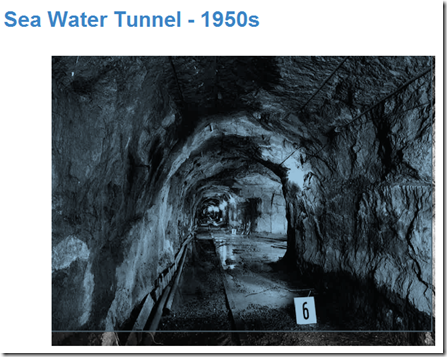
Joe Kava is featured in the videos, but the video I would have really like to see is Joe scuba diving through the sea water tunnel that brings water into the facility.  Below is a picture of the tunnel built in 1950.
image

If you want to see what the facility looked like before check out this tour Google gave to the press.

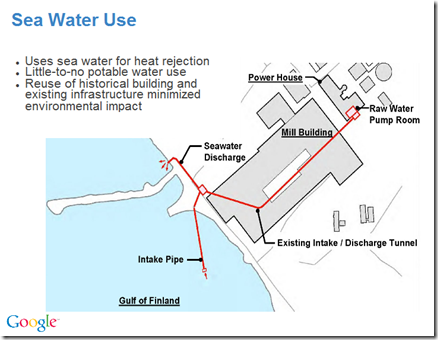
100% sea water use for cooling is a first for the data center industry, and Hamina has some unique characteristics.
image

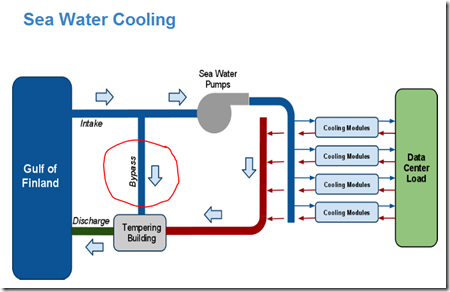
Google added a bypass mixing function to the sea water cooling system to lower the temperature of the discharge back to the gulf which was not a requirement by any government agency.  But, Google recognized this change would reduce the environmental impact which fits in a sustainability strategy.
image

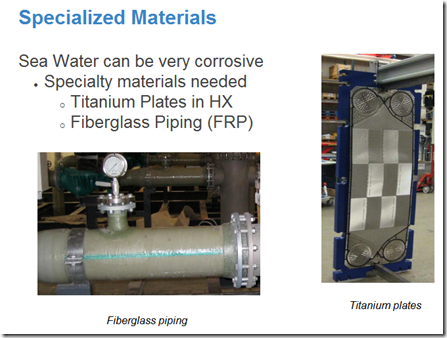
There was a lot of thought required for Google to have a sea water cooling system that runs 24x7 for years and years with no downtime.
image

I asked Joe some questions on his presentation, and one of the areas we covered is the maintenance issues for a sea water cooling system as a typical assumption at the company who designs sea water cooling systems is there is an annual maintenance that includes downtime.  You can imagine the Google guys telling the engineering company, there will be no downtime in this facility. 

Below is where Google lists an integrated Clean in Place (CIP) system and other features to address sea water fouling to eliminate maintenance downtime.

image

37Signals just posted on Ten Lessons for great landscape architecture.  You may think landscape architecture doesn’t have anything to do with data center design, but great architecture design is consistent across many areas.

Ten design lessons from Frederick Law Olmsted, the father of American landscape architecture Matt May 23

Latest by Naomi Tapia

Frederick Law Olmsted (1822-1903), the father of American landscape architecture, may have more to do with the way America looks than anyone else. Beginning in 1857 with the design of Central Park in New York City, he created designs for thousands of landscapes, including many of the world’s most important parks.

His works include Prospect Park in Brooklyn, Boston’s Emerald Necklace, Biltmore Estate in North Carolina, Mount Royal in Montreal, the grounds of the U.S. Capitol and the White House, and Washington Park, Jackson Park and the World’s Columbian Exposition of 1893 in Chicago. (The last of those documented excellently in Erik Larson’s book The Devil in the White City.) Plus, many of the green spaces that define towns and cities across the country are influenced by Olmsted.

Consider Lesson #1 of a great architect.

1) Respect “the genius of a place.”
Olmsted wanted his designs to stay true to the character of their natural surroundings. He referred to “the genius of a place,” a belief that every site has ecologically and spiritually unique qualities. The goal was to “access this genius” and let it infuse all design decisions.

This meant taking advantage of unique characteristics of a site while also acknowledging disadvantages. For example, he was willing to abandon the rainfall-requiring scenery he loved most for landscapes more appropriate to climates he worked in. That meant a separate landscape style for the South while in the dryer, western parts of the country he used a water-conserving style (seen most visibly on the campus of Stanford University, design shown at right).

Think about these words and watch the video again.  Right at the beginning Joe talks about designing for the unique characteristics of a site.

You may think this idea is a waste of time and you don’t have the money, but 30 years from now or a 100 years from now great data center designs, designs that match a site will last and be upgraded.  Data Centers that are not designed for “the genius of a place” will fade and be demolished.

50 Open Source Machines, imagine Facebook’s Open Compute Project doing the same

TED conference has a presentation by Marcin Jakubowski on Open-sourced blueprints for civilization.  Here is a video of Marcin’s talk.  It is 4:11.

Here are excerpts from the transcript.

We've identified the 50 most important machines that we think it takes for modern life to exist -- things from tractors, bread ovens, circuit makers. Then we set out to create an open source, DIY, do it yourself version that anyone can build and maintain at a fraction of the cost. We call this the Global Village Construction Set.

Here is a radical idea. Can you imagine a data center built like this?

I realized that the truly appropriate, low-cost tools that I needed to start a sustainable farm and settlement just didn't exist yet. I needed tools that were robust, modular, highly efficient and optimized, low-cost, made from local and recycled materials that would last a lifetime, not designed for obsolescence. I found that I would have to build them myself. So I did just that. And I tested them.And I found that industrial productivity can be achieved on a small scale.

Now you wouldn’t build this in the US, but maybe you could take this approach in an emerging market.

Wouldn’t it be cool if Facebook’s Open Compute Project supported the same vision of Marcin?

If this idea is truly sound, then the implications are significant. A greater distribution of the means of production, environmentally sound supply chains,and a newly-relevant DIY maker culture can hope to transcend artificial scarcity. We're exploring the limits of what we all can do to make a better world with open hardware technology.

Thank you.

(Applause)

What is missing from prediction of Top 5 Green Data Center Trends in 2011? Words of wisdom from a conversation with Olivier Sanche

TriplePundit has a post on the Top 5 trends in Green Data Center in 2011.

Top Five Trends for Green Data Centers in 2011

By Kathryn Siranosian | January 18th, 2011 3 Comments

Last year, Triple Pundit took an in-depth look at how companies are greening their data centers.

Now, it’s time for us to revisit that issue and ask, “What’s new?”

What’s the list of top 5?

1. Continued emphasis on efficiency –with a twist.

2. Improving business flow through virtualization and cloud computing.

3. Modularity.

4. Innovative design and design integration.

5. Continued evolution of certification and regulation.

But does this list really help you green the data center?  Something is missing.  Something more important.  Then, it came to me as I am researching stories for a eulogy I’ll give for Olivier Sanche’s memorial service.  A method that Olivier practiced – a passion to drive for a complete system that works and is better than the rest.  Which now that I am writing this makes sense why Olivier fit in Apple’s culture and admired Steve Jobs when he read about the company 20 years ago.  Olivier had the same passion for data centers that Steve Jobs has for consumer products.

Read this story shared by Nic Bustamente on a conversation with Olivier Sanche.  You’ll get the idea.

I was lucky enough to meet with Olivier a few weeks before his passing. We conversed about many issues. I was always amazed how he ably wore so many hats. Many folks in the industry wear one or a few hats, but Olivier wore them all so well. We fondly discussed typical data center guy stuff – outages, uptime, maintenance, design, construction – it went on for hours. Throughout the discussion he never seemed to tire. Olivier was ten years my senior, and I was starting to wear out. It was both embarrassing and humbling. I was battling bronchitis, (which later developed in to pneumonia) but we kept talking!  He continued asking me pointed and highly in depth questions. I was honestly starting to get pretty physically tired, but he was so mentally engaging I didn’t want it to end, and he kept me on my toes. It always amazed me how enthused and lively he could be with his energy – his questions and the discussion kept me going. We started discussing our various company’s positions and learned that later on that month we were due to meet up again at an industry event. We talked about how many in the industry present the same thing every year, how things don’t change too often, or as much as we would like. There are very few folks in this world who drive real change, and even fewer who embrace it. Of those among us who are agents of both, Olivier was one who you could always count on to do so intelligently and thoroughly, but most importantly, without ego. His was always a passionately genuine and humanistic approach. I am glad we had the opportunity to talk one last time, and I will always cherish the final experience.

I have a hard time thinking about it, cause every time I do I start to honestly cry. I didn’t think in a million years we would have to say goodbye like this.

Read more

Human Spirit and Creativity applied to leveraging hidden assets

if you discuss energy efficiency and greening a data center you’ll get a long list of PUE, hot-cold aisle, power systems, air side economizers.  Rarely do you get creative work.  What do I mean by creative?  Consider this post on Design Steps to Heaven.

Design steps to heaven

lucerne_cultural_centre_lge.jpg

I recently visted Luzern, in Switzerland, for a workshop at the oldest art and design school in Switzerland, Hochschule Luzern.

My host, Andy Polaine had asked me to set students in the first semester of the MA Design a challenge.

The task I gave them was as follows: find a neglected asset somewhere in Luzern, and design a service to increase its value to the city.

The author had a specific area he thought the students would leverage.

As the workshop began, I assumed that some groups of students would focus on the city's new cultural centre [photo above]. Designed by Jean Novel, the building had taken twenty years to conceive and plan. With an overhanging roof 35m 100 feet) above the ground, the building had cost the city 130 million euros to build.

This was an iconic building with a capital "I". I thought it must surely have potential as the focus of some new kind of civic activity.

But, he was surprised by what one first prize.  A church turned into a climbing wall.

The first joint winner was called 'Straight way to heaven'.

bouldering.png

The team had identified a church as their neglected asset,and proposed to increase its value as a meeting place by opening it up to bouldering in the city.

The group did not expect the church authorities to be thrilled by their idea, but our jury found their service communication to be so engaging that they were made joint winners.
heaven1.png

How many hidden assets (ideas) are there in the data center industry?

2nd prize was won by students who created a closed-loop service concept for a cemetery.

The second winning project in Luzern, Graveyard Alive, was especially enchanting. The group had discovered that the city's Friedhof Cemetary contained a lot of as-yet-unused space.

1506814914_52ff83559c_b.jpg

They came up with a sublime closed-loop service concept: offer people the opportunity to donate their bodies, once buried, as nutrients to save endangered plants and cultivate biodiversity.

graveyardalive1.png

Read more

Data Center Problem Solving or Process, where do you spend your time?

In 1991 after 7 years at Apple I took a sabbatical and vacation for 15 weeks re-living a  childhood summer vacation experience taking off from Memorial Day to Labor day.  It took me 6 weeks to decompress, and I was thankful I took so much time off.  One of my realizations I had is I really enjoyed solving complex product development problems.  Passionate and refreshed I returned to Apple in Sept 1991 told my manager my realization and she said, "well it's nice you like to solve problems, but we are about process here."  By April 1992, I took the leap leaving Apple to go to Microsoft to work on Windows until 2006.

I was having a great philosophical conversation last night with Kevin Francis at Silent Partner.

Kevin Francis

Kevin Francis

Growing up in Austin, Texas Kevin developed an affinity for live music, tacos and a story well-told. That background somehow resulted in an ability to put complex telecom problems into plain language that non-technical executives can understand and profit from. Previously, Kevin learned the ins and outs of his field at leading companies such as MCI, GST and CRG West. It was at XO, however, where he first met Mike and developed a friendship which would lead to the origins of Silent Partner. When he’s not in his super secret laboratory cooking up strategy for his clients, he’s most likely enjoying a cold beer and watching live music or the Texas Longhorns. Hook ’em.

We first met a couple of months ago at a data center social, and had fun talking about Texas Longhorn football as I plan on taking my 9 year-old daughter next month to her first Texas Longhorn game and to see her Uncle who was an all-American swimmer for Texas.  And, while I am in Austin I'll see the guys at Smooth-Stone and Dell. 

image

Last night Kevin and I got into an interesting discussion of how so many decisions are made by people who don't really understand the problem they are trying to solve.  And, this morning that's when it hit me.  Most people are going through a process, not a problem solving exercise.  And, this same issue of so many being about process, is causing the data center industry to be slow in changing.

What problem do you want to solve?  Many data center people want to build a data center to reduce their costs vs. collocation facilities.  So, this is a process of cost reduction. 

Silent Partner's engages with many clients who have network performance issues, scalability of their information services, and cost reduction.  The entrepreneurial start-ups are running into these type issues as they grow.

AREAS OF EXPERTISE

Pie Chart

We strive to stay at the center of our industry. At this point, we’ve experienced it all. We know what products, services, and vendors work best. We see how deals are struck and what dynamics are at play. We know exactly how much you can get for your money. We hear about new facilities before our competitors and we know which new technologies are being offered. We are essentially stockpiling information to give our clients every advantage.

If you try to take a process approach you'll many times go down a path of "covering your ass" do all the things in a way so you and your peers can't get fired which many times happen in IT as there is low tolerance for risk.  Risk-less development can be costly and ineffective, but it saves people's jobs.  Look who builds some of the most inefficient data centers and they are usually the most bureaucratic process oriented organizations.

To get out of this dilemma you can hire a good set of outside experts like Silent Partner to address the problems and not be focused on process.

Services

We never start with a price list. We get in a room with our clients and listen. Out of that comes all kinds of ideas, big and small. Sometimes we need to get them up and running, yesterday. Sometimes we need to sit back and take a more strategic view of the problem. Every solution is different.

The telecom landscape is constantly being populated and re-populated with new technologies, protocols, services, and vendors. We stay connected and close to the action—it’s the only way to ensure our customer’s success

BAR CHART ILLUSTRATING
SUCCESS RATES:
Bar Chart

Their client list is solid.

SP_logos

Where do you spend the majority of your day in process or problem solving?

I try spend the majority of my time talking to guys like Kevin Francis.

Read more